
AI search visibility is measurable, but a mention count or platform score is not enough to manage it. The useful metrics connect the questions buyers ask, the businesses AI systems recommend, the sources they cite, the accuracy of the description, and the business actions that follow.
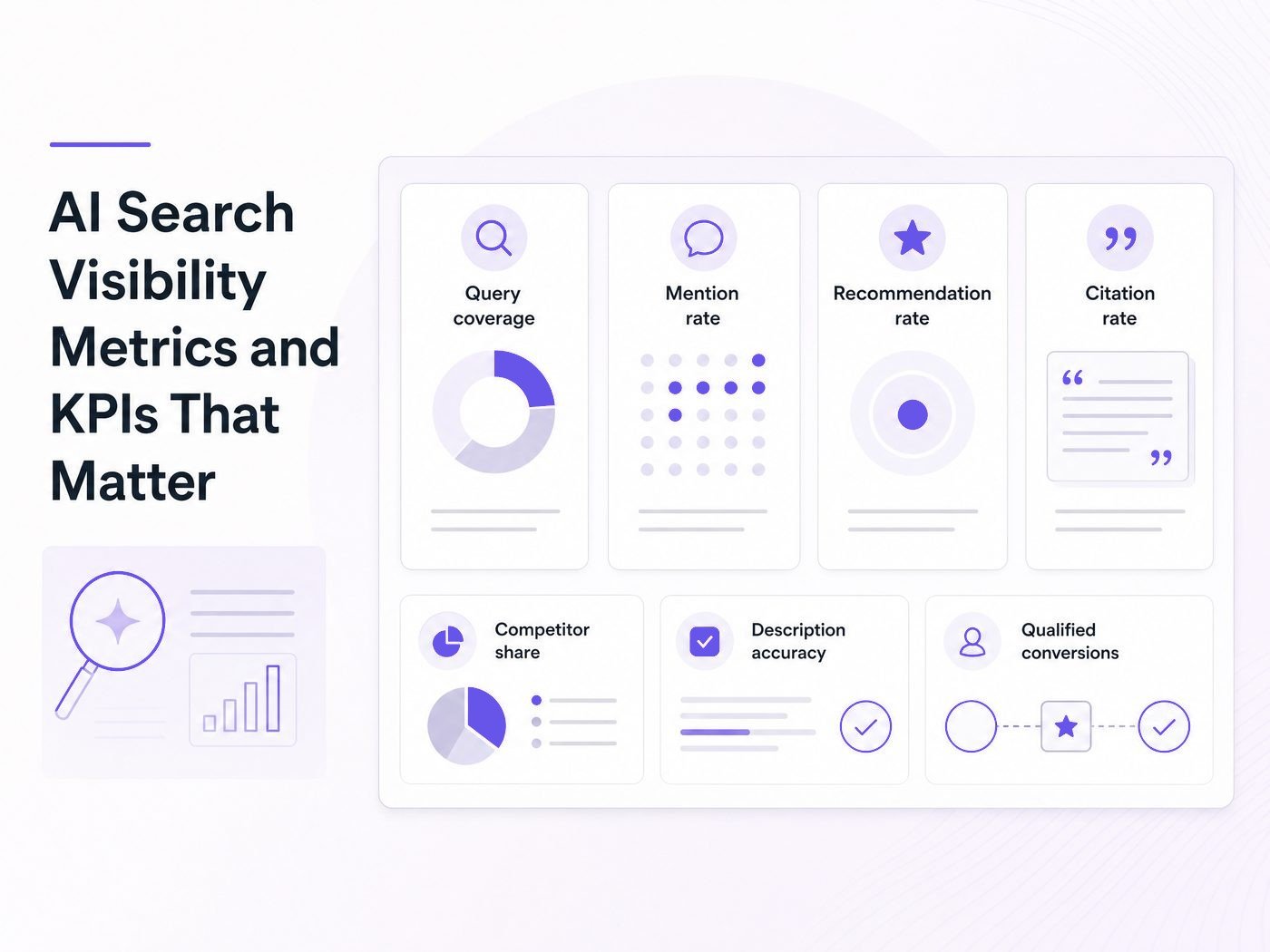
The core framework is query coverage, mention rate, recommendation rate, citation rate, competitor share, source quality, description accuracy, and qualified conversions. Report the metrics by engine and query group before combining them into a headline number.
Foundier uses these measures to establish a baseline, identify the evidence gap, and decide what needs implementation. If you need a business-specific baseline instead of a generic dashboard, start with the AI Visibility Audit.
The metrics that matter
Query coverage
Query coverage is the share of a defined buyer-question set that has been tested across the selected AI engines and conditions. It is a measurement-quality metric, not a visibility result.
A report based on five easy prompts may look positive while missing the high-value questions buyers ask before choosing a provider. Define question groups by category, service, audience, location, competitor, and brand name. Keep the set stable enough to compare over time and expand it deliberately when the business or market changes.
Mention rate
Mention rate is the percentage of tested responses in which the business is named at all. It answers a basic question: Was the business present in the response?
Mention rate should not be treated as recommendation rate. A company can be mentioned as an example, a comparison, a source, or an irrelevant result. Record the context and position of the mention instead of collapsing every appearance into one positive event.
Recommendation rate
Recommendation rate measures how often the business is presented as an appropriate option for the buyer’s stated need. This is closer to commercial visibility than a bare mention.
Define the rule before testing. For example, count a recommendation only when the response presents the business as a plausible provider for the question, not when it merely lists the brand in background context. Keep the rule consistent across dates and engines.
Citation rate
Citation rate measures how often the business or one of its pages is cited or linked as supporting evidence. A citation can show that the system retrieved a source, but it does not automatically prove that the source is accurate, influential, or commercially valuable.
Track the cited URL, source type, page topic, and whether the page actually supports the claim being made. Citation rate becomes more useful when paired with source quality and description accuracy.
Competitor share
Competitor share records which businesses appear in the same buyer-question set and how often they are recommended or cited. It changes the analysis from “Did we appear?” to “Who is being selected instead, and where is their evidence stronger?”
Use the same competitor list and query set over time. A falling competitor share can result from more of your own visibility, fewer competitor mentions, or changes in the tested questions, so keep the denominator visible.
Source quality
Source quality evaluates the usefulness of the sources supporting an AI answer. Relevant service pages, clear business profiles, credible reviews, independent publications, and accurate directories generally tell a stronger story than a random or outdated page.
Do not create artificial citations to improve this metric. The implementation task is to strengthen the real evidence and resolve contradictions across sources.
Description accuracy
Description accuracy asks whether the AI system represents the business correctly. Record whether its category, audience, services, location, differentiators, and limitations are accurate.
This metric matters even when the business is mentioned. An inaccurate recommendation can create poor-fit leads, weaken trust, and reveal an entity problem that a mention count would hide.
Qualified conversions
Qualified conversions connect AI-search visibility to actions such as a completed audit booking, consultation request, contact submission, or qualified phone call. They are not always attributable perfectly, but they are the business metric that keeps visibility work accountable.
Use analytics and booking records alongside AI visibility testing. Do not claim that a conversion came from AI search without a defensible attribution method.
A practical reporting table
| Metric | What it answers | What it does not prove |
|---|---|---|
| Query coverage | Did we test enough of the questions that matter? | That the business is visible |
| Mention rate | Was the business named? | That it was recommended or accurately described |
| Recommendation rate | Was it presented as a plausible choice? | That a buyer will convert |
| Citation rate | Was a business source retrieved or linked? | That the source was strong or the claim was accurate |
| Competitor share | Who appears instead, and how often? | Why the competitor is winning without diagnosis |
| Source quality | Is the supporting evidence relevant and credible? | Guaranteed engine behavior |
| Description accuracy | Is the business represented correctly? | That it will be selected |
| Qualified conversions | Did visibility contribute to a business action? | Perfect attribution without analytics context |
How to build a useful measurement program
Start by defining the commercial questions, not by choosing a dashboard. Separate brand, category, service, location, comparison, and problem-aware queries. Record the engine, date, location, prompt wording, response, sources, competitors, and outcome classification.
Then report each engine separately. ChatGPT, Perplexity, Claude, and Google AI Overviews may retrieve different sources and present different answer formats. A combined score can hide the exact environment where the business is absent or inaccurately described.
Finally, connect movement to work. If a new service page, entity correction, technical repair, or source improvement is implemented, note the change and retest the relevant questions after an appropriate interval. The goal is not to make a graph go up; it is to understand which evidence and implementation changes improve commercially relevant visibility.
What a tool can and cannot tell you
A visibility tool can make repeated testing easier. It may store prompts, compare dates, show competitors, and provide a history of observed outcomes. Those functions are valuable when the team already knows what to measure and how to act on it.
A metric does not diagnose a confusing service architecture, missing technical access, contradictory business descriptions, weak page evidence, or a source problem. When the numbers move but the reason is unclear, Foundier’s AI Visibility Audit turns the observations into a prioritized diagnosis and implementation decision.
How Foundier uses these KPIs
Foundier establishes the baseline across four AI environments, tests the questions that matter to the business, compares competitors and sources, reviews the technical foundation, and separates measured findings from assumptions. The result is not a decorative scorecard; it is a plan for what to fix first.
Depending on the diagnosis, the next step may be AI SEO Services, Technical SEO + Schema, AI Visibility Monitoring, or a broader AI-ready website engagement.
The audit costs $750, is delivered in five business days, tests ChatGPT, Perplexity, Claude, and Google AI Overviews, is credited toward work booked within 60 days, and is fully refunded if Foundier misses the deadline.
Related guides: How to track AI visibility · How to check brand visibility in ChatGPT · What is AEO? Answer engine optimization explained
Frequently asked questions
What is the most important AI search visibility metric?
There is no universal single metric. Recommendation rate, citation rate, description accuracy, competitor share, and qualified conversions are usually more useful than an undifferentiated mention count, but the right priority depends on the buyer questions and business objective.
What is the difference between mention rate and recommendation rate?
Mention rate measures whether the business was named. Recommendation rate measures whether the business was presented as an appropriate option for the buyer’s need. A business can have a high mention rate and a low recommendation rate.
Should I combine metrics across ChatGPT, Perplexity, Claude, and Google AI Overviews?
Report each engine separately first. Combining results can be useful for a summary, but only after the query set, denominator, classification rules, and engine coverage are clear.
How often should AI visibility KPIs be measured?
Use a stable recurring test schedule that fits the pace of the business and the work being implemented. Retest after meaningful changes, not simply to create more data points.
Can Foundier improve these metrics?
Foundier can diagnose the underlying evidence and implement agreed technical, entity, content, source, and verification work. No provider can guarantee a fixed AI answer for every query, engine, date, or location.
Measure what changes the decision
AI search metrics matter when they tell a business what happened, why it may have happened, and what to do next. Start with a defensible query set, separate visibility outcomes, and use diagnosis before buying more measurement.
Start with Foundier’s AI Visibility Audit or explore AI Visibility Monitoring after the baseline is established.
Not ready to buy yet? Get a free AI visibility snapshot: five buyer questions across four AI engines, who is named instead of you, and three fixes, in your inbox within 48 hours.

Ahmad is the Founder of Foundier, an AI SEO agency that gets businesses recommended by ChatGPT, Perplexity, Claude, and Google AI Overviews. His focus is simple: when your buyers ask AI who to hire, your name should be the answer, not a competitor's.