
Generative engine optimization, or GEO, is the work of making a real business easier for AI systems to understand, retrieve, describe, cite, and recommend for relevant buyer questions.
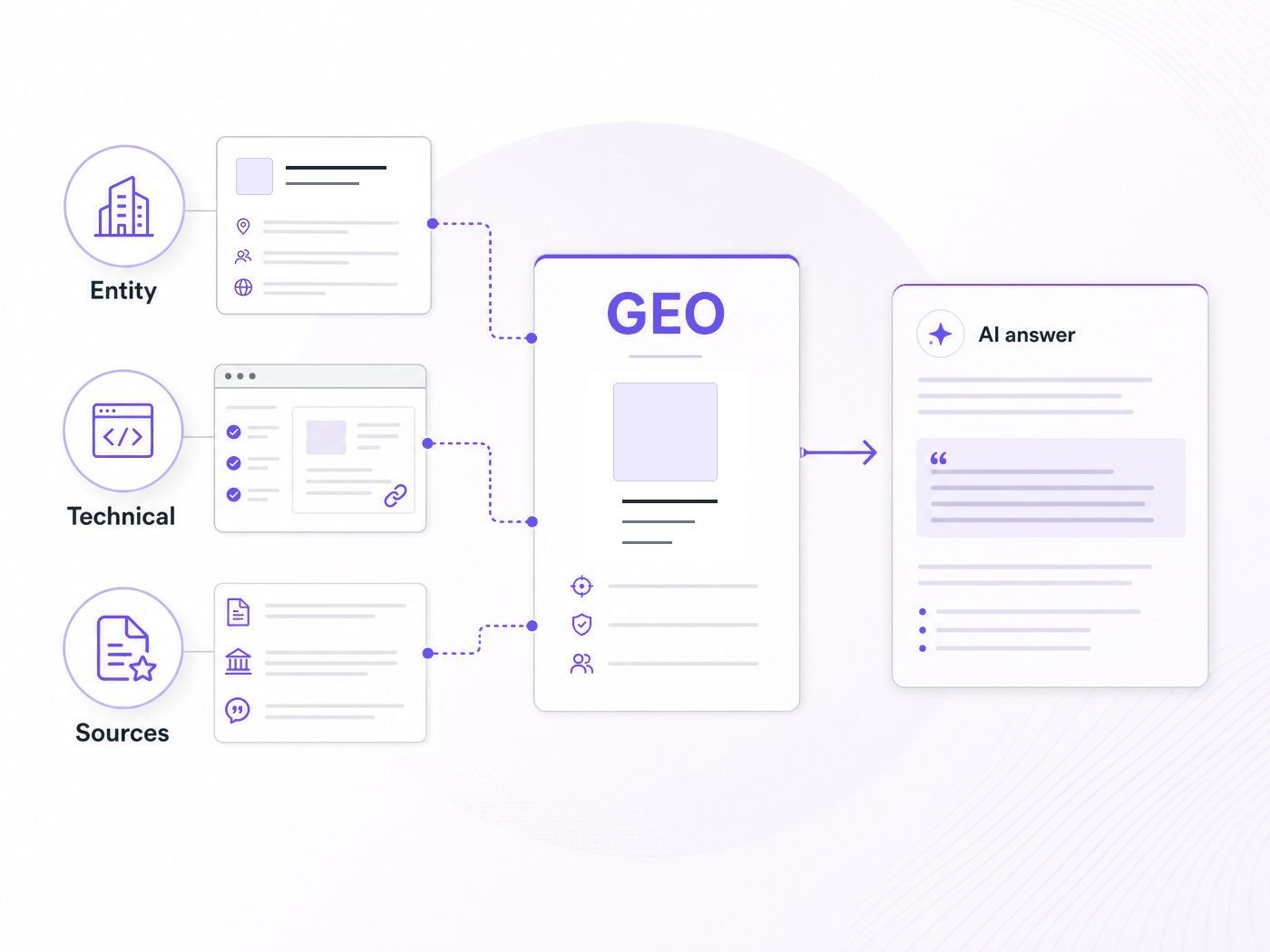
GEO is not a hidden submission form and it is not a way to force ChatGPT, Perplexity, Claude, or Google AI Overviews to mention a company. It is the practical improvement layer around the information those systems use: clear entity signals, technically accessible pages, extractable answers, consistent supporting sources, and repeatable testing.
If you are asking whether GEO is relevant to your business, the first commercial question is not “Which tool should I buy?” It is “Where is the evidence gap, and who will fix it?” Foundier starts with an AI Visibility Audit when the answer is not yet clear.
GEO in one sentence
GEO improves how an AI engine understands and represents a business when a buyer asks a relevant question.
That representation may take several forms. The business may be named, recommended, linked as a source, described inaccurately, compared with a competitor, or omitted. A useful GEO program measures those outcomes instead of treating a single brand mention as success.
How GEO differs from SEO
GEO and SEO share important foundations. Both benefit from useful content, accessible pages, understandable site structure, and credible supporting information. The difference is the outcome being evaluated.
| Question | Traditional SEO | GEO |
|---|---|---|
| Retrieval | Can a search engine find and rank the page? | Can an AI system retrieve the business as evidence for an answer? |
| Understanding | Does the page match the search query? | Does the system understand who the business is, what it does, and who it serves? |
| Trust | Does the page demonstrate relevance and authority? | Do the website and supporting sources corroborate the business clearly enough to cite? |
| Measurement | Rankings, organic clicks, and conversions | Mentions, recommendations, citations, competitor share, description accuracy, and conversions |
GEO does not replace SEO. It makes the existing technical, content, entity, and source work accountable to a broader set of search outcomes.
What a GEO program actually changes
Entity clarity
AI systems need a coherent picture of the business. The name, category, services, audience, service area, differentiators, team, and proof should agree across the website and relevant public sources. Conflicting descriptions make the business harder to classify accurately.
Technical accessibility
An engine cannot rely on information it cannot retrieve or interpret. Crawlable pages, sensible canonicals, descriptive internal links, a current sitemap, fast templates, and accurate structured data make the business evidence easier to process.
Extractable answers
Priority pages should answer the buyer’s question directly, define important terms, explain who the service is for, state constraints, and make key facts easy to quote accurately. This is not about flattening a brand’s voice; it is about removing ambiguity from the information that matters.
Source corroboration
A company website is only one source. Professional profiles, directories, reviews, publications, partners, and other credible references may reinforce or contradict the business description. GEO work strengthens the consistency of real evidence rather than manufacturing mentions.
Testing and iteration
A GEO program uses a stable set of buyer questions and records which systems mention the business, how they describe it, what sources they cite, and which competitors appear. Changes are then tested again instead of being assumed to work.
What GEO is not
GEO is not a guarantee of inclusion in every AI answer. It is not a shortcut around relevance, quality, or trust. It is not adding “AI” or “GEO” to every page, creating dozens of near-duplicate articles, or publishing artificial reviews and citations.
It is also not the same as buying a dashboard. A tool can help record repeated observations. It does not automatically explain why a service architecture is confusing, which pages compete, whether the entity is inconsistent, or what should be implemented first.
When a business needs a specialist
A business can understand the basic concept of GEO without hiring anyone. The specialist requirement appears when the work crosses multiple systems and the cost of the wrong priority is high.
| Situation | Best next step |
|---|---|
| You want to understand the terminology | Read the framework and define the buyer questions that matter |
| You need a repeatable record of mentions and citations | Use monitoring after deciding what to measure |
| You know the site has technical or content problems | Commission implementation with a defined scope |
| You do not know why competitors are being named instead | Start with Foundier’s AI Visibility Audit |
| You are an agency that needs specialist delivery for a client | Discuss Foundier’s agency partnership pathway |
Foundier’s job is to separate those situations. The diagnosis may lead to AI SEO Services, Technical SEO + Schema, an AI-ready website, or AI Visibility Monitoring.
What Foundier delivers
Foundier treats GEO as an implementation problem, not a new label for a generic content retainer. Depending on the diagnosis, the work can include:
- Testing customer questions across ChatGPT, Perplexity, Claude, and Google AI Overviews.
- Measuring mentions, recommendations, citations, competitor presence, and description accuracy.
- Auditing crawlability, schema, page quality, site structure, and internal links.
- Clarifying the entity, services, audience, and differentiators.
- Restructuring priority pages so the important answers are easier to retrieve and extract.
- Resolving inconsistent descriptions across the website and relevant sources.
- Retesting representative questions after implementation.
The AI Visibility Audit costs $750, is delivered in five business days, tests four AI engines, is credited toward an engagement booked within 60 days, and is fully refunded if Foundier misses the deadline.
Getting help with GEO
If you would rather have GEO done for you, Foundier’s GEO and AI search optimization service tests your visibility across ChatGPT, Perplexity, Claude and Google AI Overviews, fixes the technical and entity foundation, restructures key pages and builds corroboration, with fixed prices from $3,000. The same service covers LLM SEO: how ChatGPT, Claude and Gemini describe your brand.
Related guides: What is AEO? Answer engine optimization explained · What is llms.txt, and do you need one? · How to show up in Google AI Overviews and AI Mode
Frequently asked questions
What does GEO stand for?
GEO usually stands for generative engine optimization. It describes the work of improving how a business or source appears in generative AI answers.
Is GEO the same as AI SEO?
The terms overlap. AI SEO is often the broader service category, while GEO emphasizes the generative-answer outcome: retrieval, recommendation, citation, description, and business impact.
Do I need a GEO tool?
A tool can help with repeated testing and historical records. Choose one when your team can interpret the data and implement the changes. Hire a specialist when the problem spans technical SEO, entity clarity, content, sources, and verification.
Does GEO guarantee AI recommendations?
No. A responsible program can establish a baseline, improve the underlying evidence, implement agreed work, and retest representative questions. It cannot guarantee a fixed answer for every prompt, location, date, or engine.
The practical definition
GEO is the disciplined work of making a real business easier for AI systems to understand, trust, and represent accurately. When the problem is unclear or spans more than one technical and content layer, start with a diagnosis rather than another acronym or dashboard.
Start with Foundier’s AI Visibility Audit or discuss an agency partnership.
Not ready to buy yet? Get a free AI visibility snapshot: five buyer questions across four AI engines, who is named instead of you, and three fixes, in your inbox within 48 hours.

Ahmad is the Founder of Foundier, an AI SEO agency that gets businesses recommended by ChatGPT, Perplexity, Claude, and Google AI Overviews. His focus is simple: when your buyers ask AI who to hire, your name should be the answer, not a competitor's.