
When buyers ask ChatGPT, Perplexity, Claude, or Google AI Overviews who to hire, your business may be mentioned, recommended, cited, compared with a competitor, described inaccurately, or ignored. Tracking those outcomes gives you evidence about what AI systems are showing—not a guarantee that a buyer will choose you.
To track brand mentions in AI search, run a fixed set of buyer questions across ChatGPT, Perplexity, Claude, and Google AI Overviews on a regular schedule, and record six things every run: whether your business was mentioned, whether it was recommended, which URL was cited, which competitors appeared, whether the description was accurate, and the date and engine. Storing the full response rather than only a score is what makes results comparable over time. For Google’s own AI features, add Search Console data on top, because it is the only first-party source available.
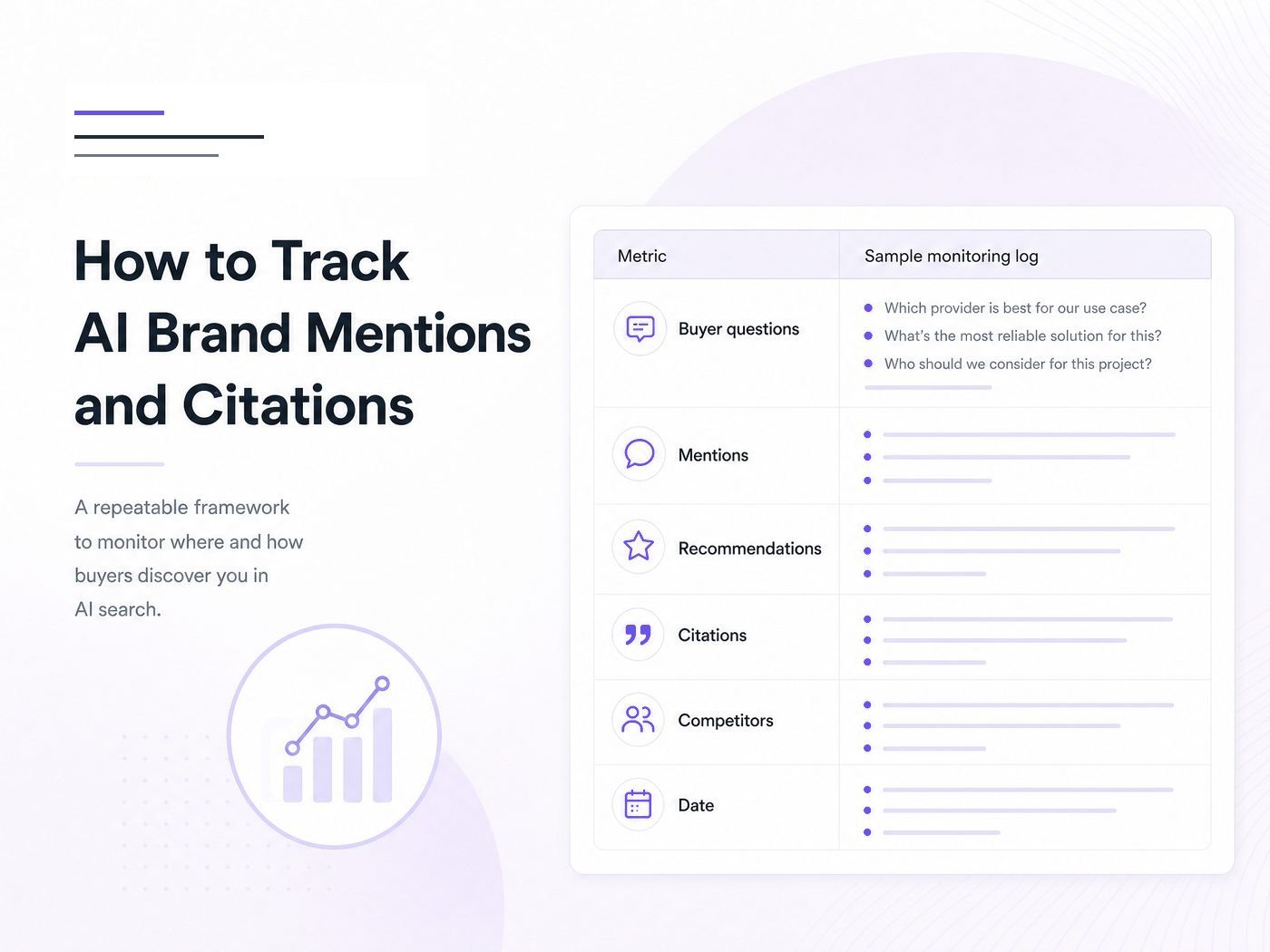
A useful program tracks the same buyer questions across the same engines, competitors, locations, and dates. It separates a bare mention from a recommendation, and a citation from a source link. Monitoring shows movement; it does not explain or implement the fixes that create movement.
If you need to know why competitors are being named or what to change, start with Foundier’s AI Visibility Audit rather than buying a dashboard first.
A monthly AI visibility check in five steps
Fix the questions
15 to 25 questions your buyers really ask. Keep them stable.
Run every engine
ChatGPT, Perplexity, Claude and Google AI Overviews.
Record six fields
Mentioned, recommended, cited URL, competitors, accuracy, date.
Compare
Your rate against the competitors named instead.
Fix and re-run
Change one thing, then repeat next month.
What to track when you track brand mentions in AI search
Mentions
A mention means the business name appears in the response. Record the exact wording and context. A passing reference, an example, and a recommended provider are different outcomes even though each counts as a mention.
Recommendations
A recommendation means the system presents the business as a plausible option for the buyer’s need. Define the classification before you begin so different reviewers do not label responses inconsistently.
Citations and source links
Record whether the answer links to the business website or another source, which URL is cited, and whether that page supports the description. A link is evidence of retrieval; it is not proof that the page is authoritative or that the recommendation is accurate.
Competitor share
Record which competitors appear in the same question set and how often each is recommended or cited. This makes the analysis commercially useful: it shows who is being selected instead of your business and where their public evidence may be stronger.
Description accuracy
Check the business category, services, audience, location, differentiators, and limitations in the answer. A business can be visible and still be represented incorrectly, creating poor-fit leads or reputational risk.
Qualified actions
Connect visibility observations with completed audit bookings, consultation requests, contact submissions, and qualified calls where your analytics and CRM allow it. Avoid claiming that a lead came from AI search without a defensible attribution method.
The best way to track brand mentions in AI search: a stable query set
Do not begin with random prompts. Build a small set of questions that represent how buyers discover and compare the business.
| Query group | Example purpose |
|---|---|
| Category | Which providers solve this type of problem? |
| Service | Who offers the specific service? |
| Problem | What should a business do about this problem? |
| Comparison | Which providers or approaches should a buyer compare? |
| Location | Which relevant providers serve this area? |
| Brand | What does the system know about this business? |
Keep the core questions stable so the results can be compared. Add new questions in a separate exploratory set instead of replacing the original denominator every week.
Record every test consistently
For each run, record the engine, date, location, logged-in or logged-out state where relevant, exact prompt wording, full response, cited sources, businesses named, classification, and reviewer notes. Store the raw response rather than only a score.
| Field | Why it matters |
|---|---|
| Engine | Results differ across ChatGPT, Perplexity, Claude, and Google AI Overviews |
| Date and location | Context can change the answer and makes comparisons fairer |
| Exact question | Small wording changes can change retrieval and recommendations |
| Mention and recommendation | Separates presence from commercial relevance |
| Cited URL and source type | Shows which evidence was retrieved |
| Competitors named | Reveals the alternative set a buyer sees |
| Description accuracy | Identifies incorrect positioning and entity problems |
| Action taken | Links movement to implementation rather than guesswork |
Track Google AI Overviews and AI Mode in Search Console
Google is the one AI search provider that gives site owners first-party data. Clicks and impressions from AI Overviews and AI Mode are included in Search Console’s Performance report under the Web search type, mixed in with the rest of your search traffic. In June 2026 Google also began rolling out dedicated Search Generative AI performance reports, starting with a subset of sites, which break out impressions inside AI-generated responses by page, country, device and date.
Use it alongside your question set, not instead of it. The new reports don’t show which queries triggered the AI answer, and nothing in Search Console covers ChatGPT, Perplexity or Claude. If your pages earn impressions in AI features but your question set shows competitors being named, the gap is in recommendation, not visibility.
AI visibility trackers vs a fixed test set
| Method | What it shows | Limits |
|---|---|---|
| Fixed question set, run by hand | Exact answers, who is named, how you are described, which sources are cited | Takes time; small sample |
| AI visibility tracker (Profound, Peec AI, Semrush AI Visibility Toolkit and others) | Mention and citation rates across many prompts and engines, trends and competitor share | Paid; scores are samples of variable answers; no access to Google’s internal systems |
| Google Search Console | First-party impressions and clicks, including AI Overviews and AI Mode | Google only; AI data not broken out by query |
For most small and mid-sized businesses, a monthly fixed question set plus Search Console is enough to start. A tracker earns its cost when you need many prompts, many locations or weekly trend lines. Our AI SEO tools comparison covers the trackers in more detail, and our guide to checking brand visibility in ChatGPT walks through a single-engine test.
How to interpret movement in AI mentions and citations
A higher mention rate is not automatically a better business result. A page may be cited while the description is wrong. A competitor may disappear because the question changed. A recommendation may improve in one engine while remaining absent in another.
Report each environment separately before building a combined summary. Track query coverage, mention rate, recommendation rate, citation rate, competitor share, source quality, description accuracy, and qualified conversions as distinct measures. The AI Search Visibility Metrics and KPIs article explains the measurement framework in more detail.
What monitoring cannot diagnose
Monitoring can show that visibility changed. It does not, by itself, tell you whether the cause was a confusing service structure, blocked or unstable pages, inconsistent business descriptions, weak source corroboration, missing schema, unclear answers, or a competitor with stronger evidence.
A tool can store observations and make recurring tests easier. It will not take responsibility for rewriting priority pages, correcting entity signals, repairing technical access, or verifying the work after implementation. That is the difference between monitoring and specialist delivery.
How Foundier uses the data
Foundier begins with the questions that matter to the business, tests the relevant engines, compares the competitors and sources being surfaced, and reviews the website’s technical and content evidence. The objective is to turn a monitoring result into a prioritized implementation decision.
Depending on the diagnosis, Foundier may recommend AI SEO Services, Technical SEO + Schema, an AI-ready website, or continuing AI Visibility Monitoring.
The audit costs $750, is delivered in five business days, tests ChatGPT, Perplexity, Claude, and Google AI Overviews, is credited toward work booked within 60 days, and is fully refunded if Foundier misses the deadline.
Frequently asked questions
Is it possible to track brand mentions in AI answers?
Yes, though not the way rank tracking works. AI answers vary by phrasing, account state, and location, so a single run tells you very little. What is trackable is the rate: ask the same fixed question set on the same schedule, and record how often your business is named across enough runs for the pattern to be readable. That gives you a defensible trend rather than an anecdote.
How do you increase AI citations?
Citations follow useful, retrievable evidence. Make sure your pages can be crawled and indexed, answer the questions buyers actually ask with first-hand detail, keep structured data accurate, and make your business description consistent across every third-party source that mentions you. Google says there is no special markup or format for its AI features; it rewards the same people-first content as Search. Our explainer on answer engine optimization covers the rest.
How do you increase visibility with AI brand mentions?
Start by separating the two problems tracking reveals: not being mentioned at all, and being mentioned inaccurately. The first is usually an entity and evidence gap. The second is a description problem, and it can cost more than absence, because a wrong description produces poor-fit enquiries. Diagnose which one you have before deciding what to change.
Can I see AI Overviews traffic in Google Search Console?
Yes. Clicks and impressions from AI Overviews and AI Mode are included in the Performance report under the Web search type. Google began rolling out separate generative AI performance reports in June 2026, starting with a subset of sites, which show impressions inside AI answers by page, country, device and date.
How often should I track AI brand mentions?
Use a recurring schedule that matches the pace of your market and implementation work. Keep a stable core query set, retest after meaningful changes, and avoid treating a single result as a trend.
Is a brand mention the same as a recommendation?
No. A mention only means the business was named. A recommendation means the system presented it as a plausible option for the buyer’s stated need.
What is the difference between a citation and a mention?
A mention is text in the answer. A citation or source link indicates that the system retrieved a source as supporting evidence. Track both because they answer different questions.
Can a tracking tool fix AI visibility?
A tool can help you observe and record outcomes. It does not replace technical, content, entity, source, or implementation work. Choose Foundier when you need the diagnosis and fix handled by a specialist.
Can Foundier monitor AI brand mentions for my business?
Yes. Foundier’s AI Visibility Monitoring is designed for continuing measurement after the baseline and implementation priorities are established. Monitoring does not guarantee permanent inclusion or recommendations.
Track what buyers actually see
AI brand monitoring becomes valuable when the test set is stable, the classifications are honest, and the result changes a business decision. Track the evidence first. Then use a diagnosis to decide what should be implemented.
Start with Foundier’s AI Visibility Audit or explore AI Visibility Monitoring.
Not ready to buy yet? Get a free AI visibility snapshot: five buyer questions across four AI engines, who is named instead of you, and three fixes, in your inbox within 48 hours.

Ahmad is the Founder of Foundier, an AI SEO agency that gets businesses recommended by ChatGPT, Perplexity, Claude, and Google AI Overviews. His focus is simple: when your buyers ask AI who to hire, your name should be the answer, not a competitor's.