
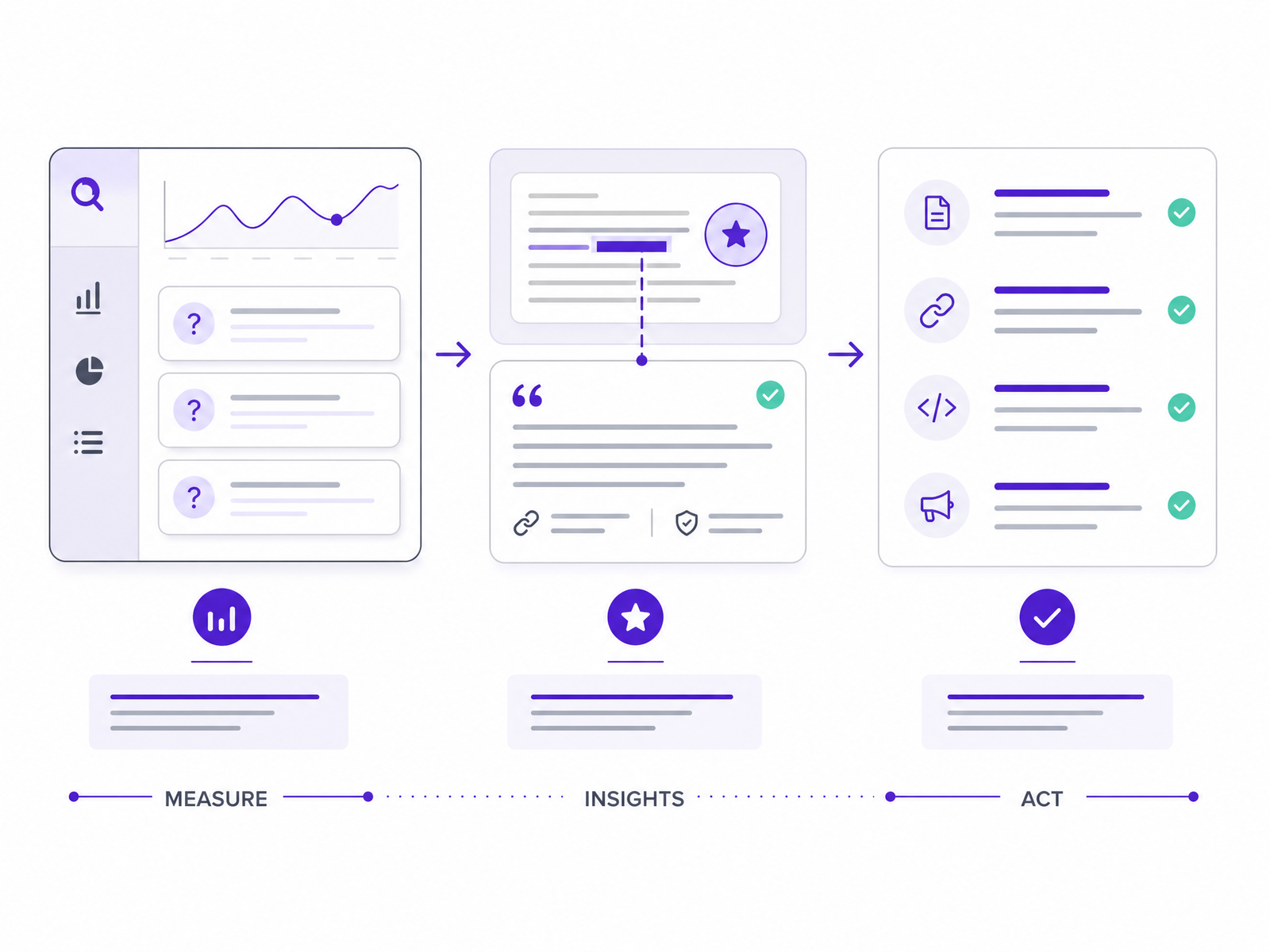
What are AI search optimization tools?
AI search optimization tools are software products that help a team observe, analyze, or improve how a business appears in AI-powered search experiences. Depending on the product, a tool may collect brand mentions, test prompts, compare competitors, track citations, audit technical signals, or recommend changes to content and entities.
The phrase is broad, which creates much of the confusion. Some products are visibility checkers. Some are monitoring platforms. Some are AI-assisted SEO tools that help with research or content analysis. Others are marketed as optimization platforms even though they mainly report what happened. A managed agency service is different again: it includes expert diagnosis, prioritization, implementation, and accountability rather than only a software interface.
The most important distinction is this:
A tool can help you observe a visibility problem. It does not automatically become the solution to that problem.
A useful tool makes evidence easier to collect and compare. A useful optimization program explains what the evidence means and changes the underlying signals that influence how the business is understood.
The five types of AI search tools
1. AI visibility checkers
A visibility checker tests a set of prompts and records whether a brand appears, how it is described, which competitors are mentioned, and whether sources or citations are shown. It can provide a useful starting point for a business that has never checked its presence in AI search.
The limitation is that a checker often captures an outcome without explaining the cause. A single prompt can also produce a misleading sense of certainty. Results may change with the question, model, location, date, or available sources. A checker is most useful when it supports a repeatable testing method rather than a one-time screenshot.
2. AI brand-mention and citation trackers
Tracking tools monitor whether a brand, product, executive, or competitor is mentioned across a defined set of prompts or AI systems. Some also record citations, source pages, sentiment, or changes over time.
This category is valuable when a business needs ongoing visibility intelligence. It can reveal that a brand is mentioned but not recommended, recommended but inaccurately described, or repeatedly omitted from a category where it should be considered. Tracking is measurement, however. It does not by itself improve the website, correct an entity description, or earn a credible source reference.
3. AI search monitoring platforms
A monitoring platform usually combines prompt testing, competitor comparison, historical records, reporting, and alerts. It may be useful for a marketing team that needs a shared view of visibility across several brands, markets, or business units.
The right evaluation question is not simply “How many dashboards does it have?” Ask whether the platform lets the team see the exact prompts tested, the date and context of each result, the sources cited, and the difference between mention, recommendation, and accurate description. If those details are hidden behind one score, the platform may be difficult to use for serious diagnosis.
4. AI-assisted SEO and content tools
These tools may help with keyword research, content briefs, entity extraction, topical coverage, summaries, or page comparisons. They can increase the speed of research and editorial production, but speed is not the same as authority.
A content assistant cannot verify a company’s real differentiators, inspect whether the public web corroborates its claims, or decide whether a recommendation is supported by reliable evidence. It can help a practitioner work; it should not replace the practitioner’s judgment.
5. AI search optimization services
A managed optimization service is not a software category. It is a delivery model that combines investigation, strategy, implementation, verification, and sometimes monitoring. It may include technical SEO, schema, entity clarity, content restructuring, source-corroboration priorities, and measurement design.
This is the category Foundier provides. Foundier uses visibility evidence as an input, then diagnoses and implements the work needed to make an established business easier for AI search systems to understand and recommend. The service is not a claim that a particular engine can be controlled. It is a structured effort to improve the quality and clarity of the underlying evidence.
What can AI search optimization tools actually measure?
The answer depends on the product, but a credible tool should make the observation understandable rather than hiding it behind a single score.
| Measurement | What a tool may show | What still requires expert interpretation |
|---|---|---|
| Brand mention | Whether the business appeared in a sampled answer | Whether the query was commercially relevant and whether the mention was meaningful |
| Recommendation | Whether the brand was presented as a suitable option | Whether the recommendation was accurate, qualified, and competitive |
| Description accuracy | How the business was categorized or described | Which website, entity, or source problem caused the inaccurate description |
| Citation presence | Whether a response linked to the business or another source | Whether the cited source is authoritative, relevant, and consistent with the business |
| Competitor share | Which alternatives appeared in the same prompt set | Why those competitors are easier to retrieve or recommend |
| Trend over time | Whether observed outcomes changed across dates | Which implemented changes plausibly influenced the change |
| Technical signals | Selected crawl, schema, or content observations | Which fixes matter most to the business outcome and how to implement them safely |
Measuring these outcomes well is its own discipline, covered in detail in AI search visibility metrics and KPIs that matter. This guide focuses on how tools fit into the broader decision between observing, diagnosing, and implementing.
Why use AI search monitoring tools?
Monitoring is useful when visibility can change and the business needs a record of those changes.
Monitoring can help a team identify whether a brand is being named for the right category, whether competitors are gaining share in important prompts, whether descriptions are becoming more accurate, and whether citations appear from the sources the business wants users to trust. It can also make internal reporting more consistent when several people are testing visibility.
Monitoring is less useful when the team has not defined the questions, systems, competitors, and business outcomes it cares about. Collecting hundreds of undifferentiated prompts can create noise. A smaller, commercially meaningful prompt set is usually easier to interpret and more useful for deciding what to fix.
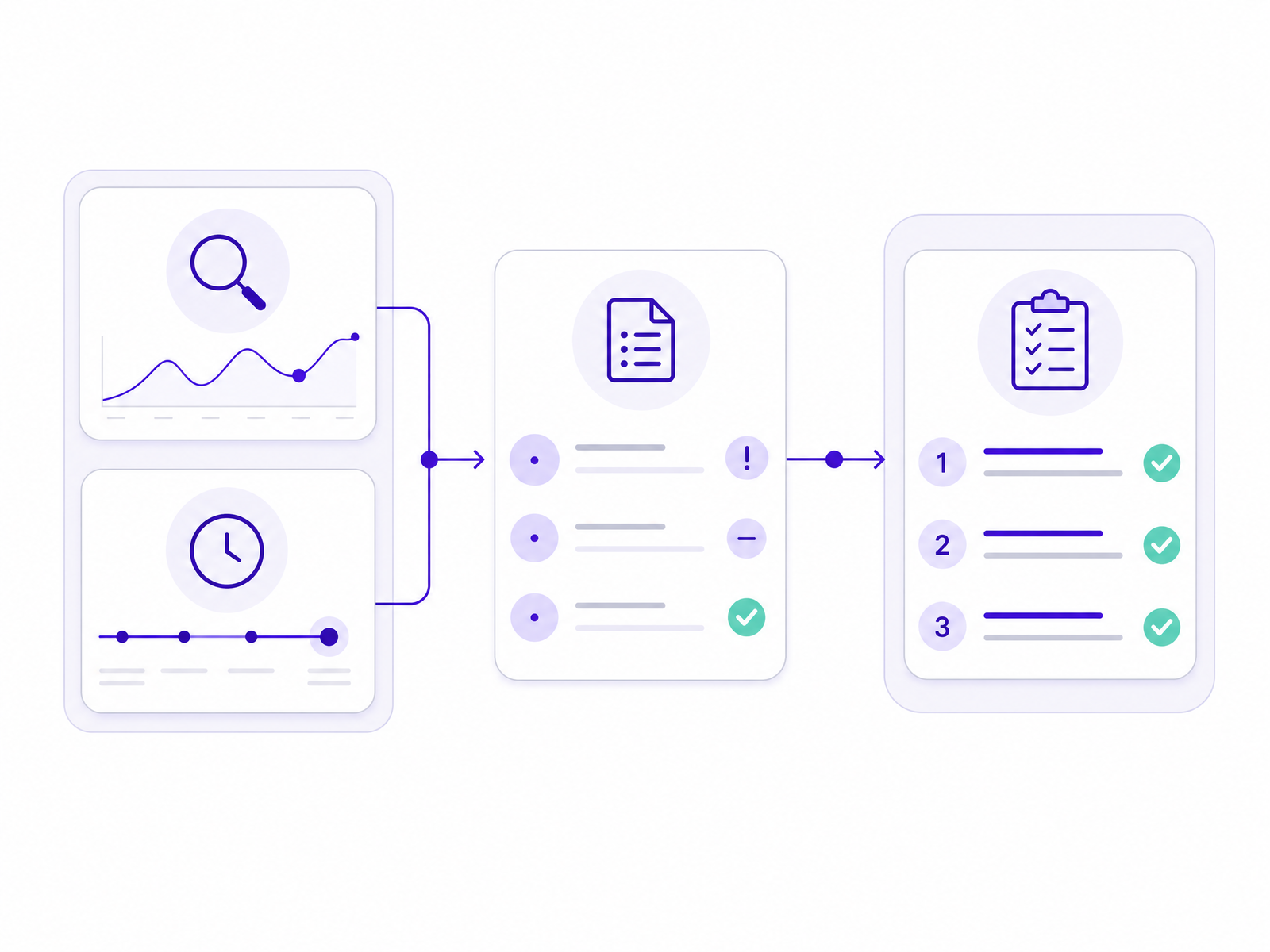
AI visibility checker versus AI search optimization service
The decision is not always either-or. The two options solve different problems.
| If you need to… | A tool may be enough when… | An expert service is more appropriate when… |
|---|---|---|
| Run recurring prompt checks | Your team can define and maintain a useful prompt set | You do not know which prompts reveal the real commercial problem |
| Compare brand and competitor mentions | You only need directional monitoring | You need competitor interpretation and prioritized action |
| Track citations | You already have a process for evaluating source quality | Your public sources are inconsistent or your evidence is weak |
| Audit technical and content signals | The product has credible diagnostics and your team can implement changes | The issue spans technical SEO, entities, content, and source corroboration |
| Improve visibility | Your team has the expertise, time, and authority to make the changes | You want a practitioner to diagnose, implement, and verify the work |
A tool becomes more valuable when it is connected to a clear operating process. Without that process, the business may accumulate scores without knowing what action to take. An agency becomes more valuable when it does more than export a dashboard: it should explain the evidence, make appropriate changes, and show what was verified afterward.
What AI search tools cannot do by themselves
They cannot guarantee a fixed AI answer
AI search results are not a conventional ranking position that a provider can permanently reserve. A system may use different prompts, sources, models, and context at different times. A responsible tool or agency should report patterns and limitations rather than promise that a business will always appear first.
They cannot replace entity and category strategy
If the business is described inconsistently across its website and credible public sources, a dashboard may reveal the inconsistency but cannot decide the correct market position for the owner. The business still needs a clear category, audience, service structure, and differentiated explanation.
They cannot create evidence from nothing
A tool can identify a missing citation or a weak page. It cannot invent genuine expertise, customer outcomes, trustworthy references, or a reason for buyers to choose the business. Those assets must come from the business and be presented accurately.
They cannot turn generic content into authority
AI-assisted writing can produce fluent paragraphs quickly. It does not automatically add first-hand knowledge, original analysis, accurate claims, or useful examples. Content still needs a real point of view and a knowledgeable reviewer.
They cannot tell you which fix deserves priority without context
A low score may be caused by a technical blockage, unclear page architecture, weak source corroboration, or an unsuitable prompt. The correct response depends on the business model and the commercial outcome being pursued. This is why Foundier treats measurement as the beginning of diagnosis, not the end of the engagement.
How Foundier uses tools without selling a dashboard as the solution
Foundier’s role is to provide the work between the observation and the business result. The process begins with the AI Visibility Audit, which examines where the business appears, how accurately it is described, which competitors are recommended, and what technical, entity, content, and source gaps should be addressed first.
The audit is deliberately diagnostic. It prevents a business from buying a monitoring subscription when the real problem is unclear positioning, inaccessible technical content, or inconsistent public information. It also prevents an agency from recommending an extensive implementation project when a smaller content or measurement change is sufficient.
After diagnosis, Foundier can implement the appropriate work through AI SEO Services or Technical SEO + Schema. Agencies can work with Foundier through the partner program. If the business needs ongoing measurement after implementation, AI Visibility Monitoring can provide the continuing observation layer.
The important point is that the tool is not the strategy. Foundier uses evidence to determine which service path makes sense, implements the work, and verifies whether the business is being understood more accurately. That is a more useful promise than selling a score as if it were a guaranteed ranking.
A practical framework for choosing an AI search tool
Before selecting a product, define the decision the tool needs to support. A small business may need a one-time check and an expert diagnosis. A larger marketing team may need recurring monitoring across several markets. An agency may need multi-client reporting and a repeatable workflow. These are different requirements.
Use the following evaluation framework:
- Define the business question. Are you trying to find out whether the brand is mentioned, why competitors are recommended, whether citations are accurate, or whether implemented work changed the result?
- Check the sampling method. Can you see the exact prompts, dates, systems, locations, and competitors included in the measurement?
- Separate outcomes. Does the product distinguish mention, recommendation, description accuracy, citation, and conversion rather than combining them into one unexplained score?
- Inspect the evidence. Can you review the answer and cited sources, not just a chart?
- Assess implementation support. If the tool identifies a problem, who will fix the technical, entity, content, or source issue?
- Connect the data to business outcomes. Can the team compare visibility observations with qualified organic visits, inquiries, audit clicks, and bookings?
- Review limitations. Does the vendor explain sampling uncertainty, changes in AI systems, and what the tool cannot measure?
A product that performs well on measurement but poorly on transparency may be difficult to trust. A product that produces recommendations without showing its evidence may be difficult to validate. The strongest setup is one where measurement is clear, interpretation is disciplined, and implementation has an accountable owner.
Related guides: Best AI SEO tools in 2026 · How to track AI visibility
Frequently asked questions
What are AI search optimization tools used for?
They are used to observe, analyze, and sometimes support improvements to how a business appears in AI-powered search experiences. Common functions include prompt testing, brand-mention tracking, competitor comparison, citation monitoring, technical checks, and content analysis. The exact capability depends on the product, and measurement should not be confused with implementation.
Are AI visibility tools the same as AI SEO tools?
Not always. AI visibility tools generally focus on what happens in AI answers: mentions, recommendations, descriptions, citations, and competitor presence. AI SEO tools may cover a wider set of research, technical, content, and optimization tasks. Vendors use these labels inconsistently, so evaluate the actual inputs, outputs, and evidence rather than the category name.
Why use AI search monitoring tools?
Monitoring tools are useful when a business needs repeated observations across a consistent prompt set and wants to see changes over time. They are most valuable when the team already knows which commercial questions matter and has a process for turning findings into action.
Can an AI visibility checker improve my rankings?
A checker can reveal a visibility pattern, but checking alone does not improve rankings or recommendations. Improvement requires changes to the underlying technical, entity, content, and source signals when those are responsible for the gap.
Should I buy a tool or hire an AI SEO agency?
Choose a tool when you mainly need recurring measurement and have the expertise to interpret and implement the findings. Choose an agency when the problem is unclear, spans several disciplines, or requires a practitioner to diagnose, implement, and verify the work. Foundier’s audit-first approach can determine which path is justified before a larger engagement is recommended.
Conclusion: choose the operating model, not just the software
AI search optimization tools can make an emerging visibility problem easier to observe. They can help a team test prompts, track mentions, compare competitors, review citations, and maintain a record of change. Those functions are useful, especially when the measurement method is transparent and tied to real business questions.
But a tool is not automatically an optimization program. A dashboard cannot create genuine expertise, repair unclear positioning, implement technical changes, or decide which evidence a buyer should trust. The business still needs a diagnosis and an accountable implementation path.
Foundier provides that path. The AI Visibility Audit identifies where the business stands and what is blocking clearer visibility. Foundier then implements the work through the service path the evidence supports, with monitoring available when ongoing measurement is justified.
If you are deciding between an AI visibility tool and an optimization service, start by identifying the problem you need the tool to solve. Then choose the delivery model that can actually act on the answer.
Start with the AI Visibility Audit
Not ready to buy yet? Get a free AI visibility snapshot: five buyer questions across four AI engines, who is named instead of you, and three fixes, in your inbox within 48 hours.

Ahmad is the Founder of Foundier, an AI SEO agency that gets businesses recommended by ChatGPT, Perplexity, Claude, and Google AI Overviews. His focus is simple: when your buyers ask AI who to hire, your name should be the answer, not a competitor's.