
If AI is naming your competitors when buyers ask who to hire, you need two things: a real framework you can act on today, and an honest read on which parts of the problem are bigger than a DIY fix. This guide gives you both.
The short version: AI Overviews and AI chat engines favor businesses that are unmistakably clear about who they are, easy to crawl and interpret, backed by consistent evidence across the web, and structured so an answer can be lifted straight off the page. Below is the practical framework. Further down, you’ll find how Foundier diagnoses and implements this work when the problem is bigger than a checklist.
Want a business-specific diagnosis instead of guessing where you stand? Start with the AI Visibility Audit: $750, five business days, tested across ChatGPT, Perplexity, Claude, and Google AI Overviews. Credited toward any engagement booked within 60 days, fully refunded if we miss the deadline.
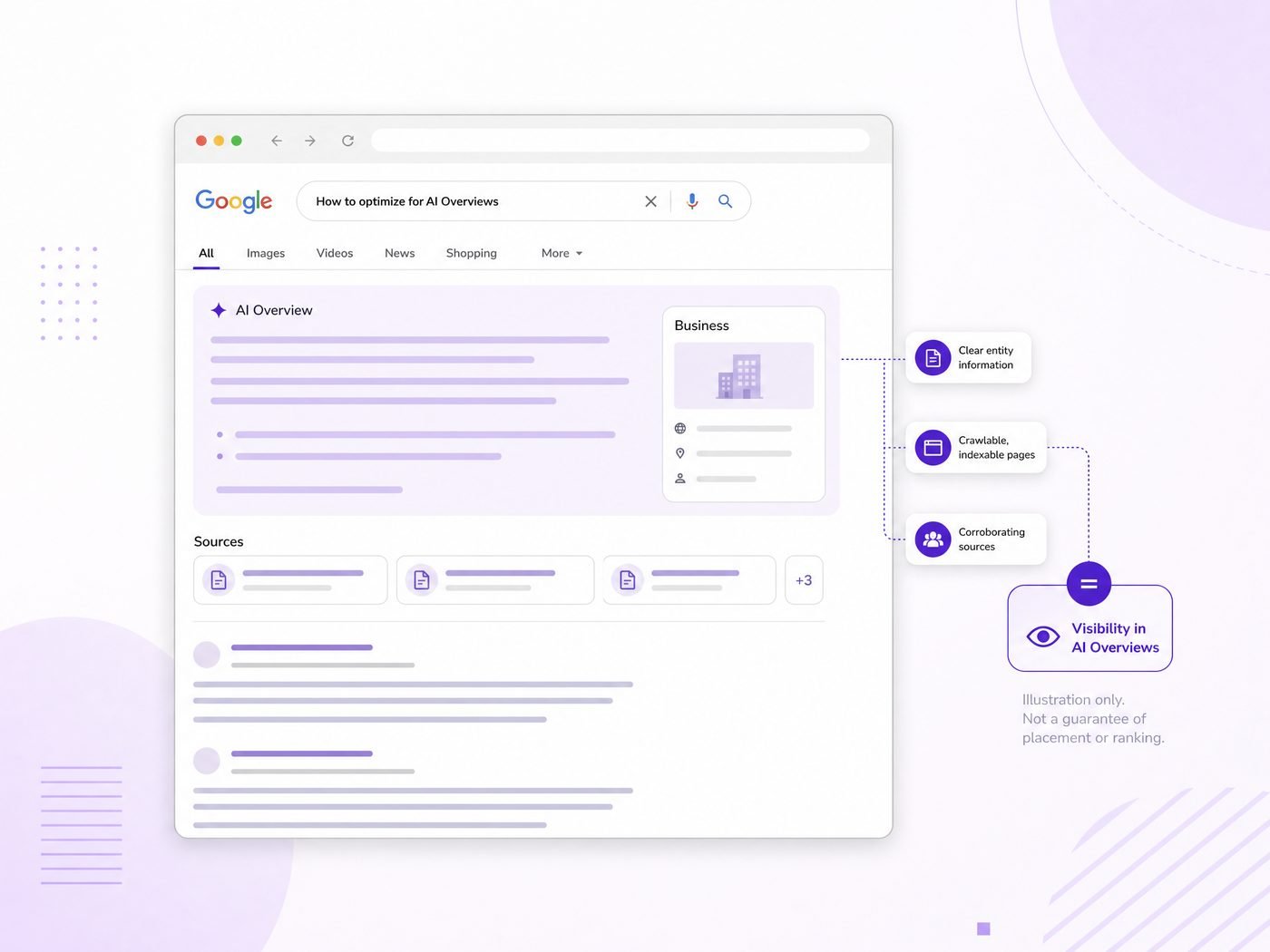
A practical framework for AI Overview visibility
These seven practices are the same ones Foundier applies during implementation. Work through them on your own site, then use the note at the end of this section to see how much is realistically left for a specialist.
1. Make your entity unmistakable
AI systems have to be confident about who you are before they’ll recommend you. That confidence comes from consistency, not from any single page.
- Use the exact same business name, description, and category everywhere: your website, Google Business Profile, LinkedIn, industry directories, and any place your business is listed.
- Add a clear About page that states what you do, who you serve, where you operate, and what makes you different, in plain sentences rather than marketing abstractions.
- Check your own name in ChatGPT, Perplexity, and Google AI Overviews. If the description it gives back is vague or wrong, that’s a direct signal something in your public footprint is inconsistent.
2. Answer the question at the top of the page
AI engines extract answers, they don’t read for tone. Every priority page should state its core answer in the first two or three sentences, in plain language, before any framing or backstory.
- Open each key page with a direct answer to the question that page exists to answer.
- Follow the direct answer with supporting detail, not the other way around.
- Avoid burying your actual offer inside a long introduction. If a reader has to scroll to find out what you do, so does an AI system.
3. Implement schema that matches what’s actually on the page
Structured data helps AI systems parse your content correctly, but only if it reflects what’s genuinely there.
- Add Organization and LocalBusiness schema so your name, category, service area, and contact details are machine-readable.
- Add Service or Product schema for your core offers, and FAQPage schema for genuine, on-page FAQ content.
- Validate every schema type with Google’s Rich Results Test, and confirm the marked-up claims match the visible page. Schema that overstates the page is a liability, not an asset.
4. Fix crawlability and technical access
None of the above matters if AI crawlers can’t reach or parse the page.
- Check robots.txt and any crawl directives aren’t accidentally blocking key pages or AI-specific crawlers.
- Submit a current XML sitemap and confirm your priority pages are actually included in it.
- Fix broken internal links, unclear canonical tags, and pages that take too long to load. Core Web Vitals issues slow down both users and crawlers.
5. Build genuine third-party corroboration
A business described only on its own website is harder for an AI system to trust. Independent confirmation matters.
- Get listed accurately in relevant industry directories, review platforms, and local or trade publications.
- Earn genuine reviews and case studies rather than generating them artificially. Fabricated proof tends to surface and damages the exact trust you’re trying to build.
- Resolve conflicting information across these sources. If your address, category, or service description differs from site to site, that inconsistency undermines everything else on this list.
6. Structure content for extraction
Write so a single paragraph could be lifted out and stand on its own as a correct, complete answer.
- Use descriptive subheadings that match how a buyer would actually phrase the question.
- Keep key paragraphs to two or three sentences, with the most important claim first.
- Use lists and short tables for anything comparative, like pricing tiers, service comparisons, or step sequences.
7. Test with real buyer questions, repeatedly
Treat this as an ongoing practice, not a one-time launch task.
- Build a small, stable set of buyer-intent questions across your category, your service, your location, and your brand by name.
- Run the same set across ChatGPT, Perplexity, Claude, and Google AI Overviews, and log the date, the answer, and who else was named.
- Retest on a schedule, not just once. AI answers shift with sourcing and context, so a single good result doesn’t confirm the fix held.
Where this gets hard to do alone: most businesses can execute one or two of these well. Doing all seven consistently, across every priority page, and telling which one is actually holding you back, is where a self-directed effort usually stalls. That’s the specialist work below.
What you are actually buying
AI Overview optimization isn’t a request form, a hidden tag, or a promise that your business will appear every time someone asks a question. It’s the work above, applied consistently, prioritized correctly, and verified afterward. At Foundier, that can include:
- Testing the customer questions that matter to your business
- Measuring whether you’re mentioned, cited, accurately described, or ignored, and who’s named instead
- Auditing crawlability, schema, site structure, page quality, and internal links
- Clarifying your entity, services, audience, and differentiators
- Restructuring priority pages so their answers are easier to understand and extract
- Resolving inconsistent descriptions across your website and relevant public sources
- Retesting representative questions after implementation so the change is measured, not assumed
The right scope depends on what the diagnosis finds. A business may need a focused technical repair. Another may need service pages rebuilt, entity signals clarified, or third-party sources strengthened. Buying the same “AI SEO package” before understanding the problem is how businesses spend money on the wrong work.
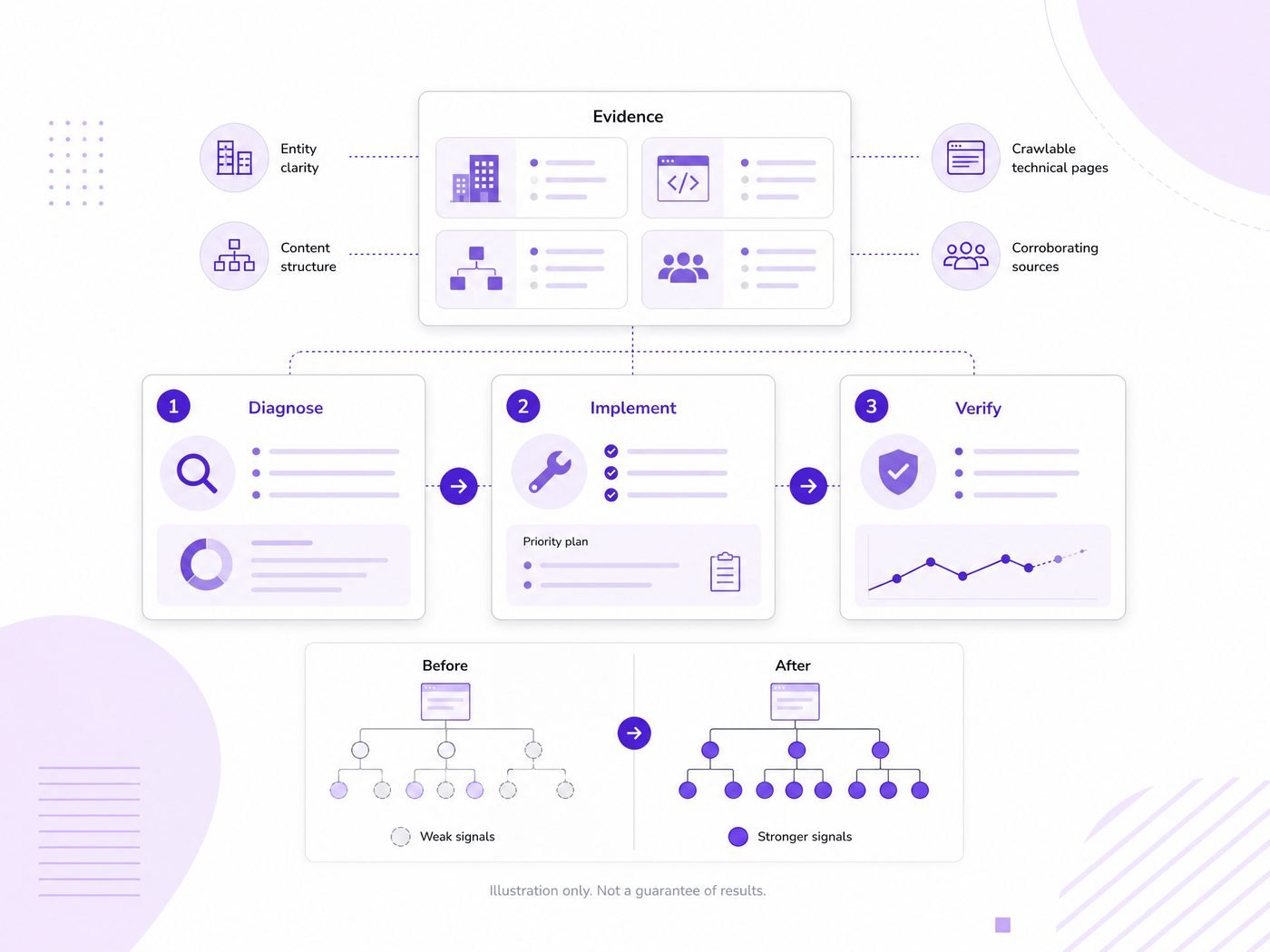
Start with the $750 audit, not a guess
A manual ChatGPT search tells you whether your name appears in one answer. It can’t tell you why you were omitted, whether the result is consistent, how competitors are represented, whether your site is technically clear, or which of the seven practices above deserves priority.
Foundier’s audit is a finished diagnosis, not a dashboard you have to learn. In five business days, you receive a business-specific view of your AI visibility and a plan you can hand to Foundier, your internal team, or another implementation partner.
| What the audit examines | What you receive |
|---|---|
| Citation presence across ChatGPT, Perplexity, Claude, and Google AI Overviews | A record of where your business appears, where it’s missing, and how it’s represented |
| The questions your customers ask AI and the variations that shape recommendations | Prompt intelligence tied to your commercial category |
| How AI describes your business compared with competitors | Share-of-voice and sentiment findings, not just a yes-or-no citation check |
| Crawlability, schema, Core Web Vitals, site structure, and the full site crawl | A technical SEO diagnosis with no arbitrary page cap |
| Which competitors are being named instead of you | Competitor citation analysis showing where the evidence is stronger |
| The gaps with the greatest business impact | A prioritized action plan separating quick wins from deeper fixes |
The audit costs $750, arrives in five business days, and is credited toward any engagement within 60 days. If Foundier misses the five-day deadline, the audit is fully refunded.
What happens after the diagnosis
The audit is designed to make the next decision easier. You may implement the recommendations internally, want Foundier to carry out the work, or need a broader website rebuild instead of optimization. The report gives you the evidence to choose.
| If the diagnosis shows… | The appropriate Foundier path may be… |
|---|---|
| Your website is structurally sound but its entity, schema, content, or citation signals are weak | AI SEO Services, from $3,000 in three fixed tiers, with before-and-after testing |
| Technical accessibility, schema, crawlability, or site structure is holding the site back | Technical SEO + Schema |
| Your site needs focused visibility work rather than a broad engagement | AI Visibility Optimization |
| The site itself needs to be re-architected or rebuilt | AI-Ready Website Design |
| You need continuing measurement after implementation | AI Visibility Monitoring, from $1,250/month, no minimum contract |
Foundier doesn’t force every business into the same path. The audit is what tells us whether optimization, technical work, a rebuild, monitoring, or a combination is justified.
How Foundier scales this across your full site
The seven practices above work for a handful of priority pages. Applying them consistently across an entire site, alongside a live business that keeps changing, is where Foundier’s implementation work picks up:
- Auditing every page against the entity, structure, schema, and extraction standards above, not just the homepage
- Resolving conflicts between your site and the public sources that describe your business
- Prioritizing fixes by business impact instead of working alphabetically through a page list
- Running the before-and-after verification testing described in step seven, on a defined schedule, so you have an actual record of what changed
Why this is different from buying a tool
A tool is useful once you already have the expertise and only need recurring measurement. It can show mention frequency, competitor presence, or changes across a prompt set. It won’t tell you whether your service architecture is confusing, whether two pages are competing, whether your schema reflects the visible business, or which fix matters most. It also won’t take responsibility for changing the live site.
- Buy a tool when you already know what to measure, how to interpret it, and who will implement the fix.
- Hire Foundier when the problem is unclear, spans technical and content work, or needs to be implemented and verified for you.
- Start with the audit when you’re not sure which of those two is true yet.
For agency owners: sell the strategy, add the specialist
Agency owners are hearing the same client questions: why does ChatGPT recommend our competitor, can you get us into Google AI Overviews, how do we know AI search is sending us business. You don’t need to pretend your agency controls an AI engine. You need a credible specialist delivery layer that can investigate the problem, do the technical and visibility work, and explain uncertainty without weakening the client relationship.
| Partnership model | How it works |
|---|---|
| Referral | You identify the opportunity and introduce the client. Foundier handles the audit and specialist engagement directly. |
| Specialist delivery | You retain the client relationship and broader marketing strategy. Foundier performs the agreed AI visibility, technical, content, and verification work behind the engagement. |
| Joint delivery | You and Foundier present one coordinated plan, with responsibilities defined before work begins. |
The agency stays responsible for the client relationship, goals, positioning, approvals, and wider marketing program. Foundier handles the specialist diagnosis and the implementation scope agreed with the client or agency. See the agency partner program if you want Foundier as the specialist layer behind your client work.
What Foundier will and will not promise
Foundier won’t promise your business will appear in every AI Overview, be cited first, or receive a fixed amount of traffic from ChatGPT, Perplexity, Claude, or Google AI Overviews. Query wording, location, date, available sources, and system behavior can all change the answer.
What we will do is concrete: establish a baseline, identify the evidence gap, implement the work within the agreed scope, retest representative questions, and explain the result honestly. You get a clearer business diagnosis and accountable implementation, not a screenshot presented as proof of permanent visibility.
We also won’t recommend fabricated reviews, invented results, artificial citations, or dozens of thin pages built only to capture keyword variations. Those tactics create a less trustworthy business, not a stronger one.
Related guides: How to show up in Google AI Overviews and AI Mode · Technical SEO audit checklist · What is llms.txt, and do you need one?
Frequently asked questions
How do I optimize for AI Overviews?
Make your entity unmistakable across the web, answer questions directly at the top of key pages, implement schema that matches what’s actually on the page, fix crawlability issues, build genuine third-party corroboration, structure content for extraction, and retest with real buyer questions on a schedule. For a business-specific diagnosis of which of these matters most for you, Foundier’s $750 audit tests the relevant questions and delivers a prioritized plan in five business days.
What’s the fastest way to improve AI Overview visibility?
Start with whichever of the seven practices above is weakest on your site. Inconsistent entity information and pages that bury the answer are the two most common and fastest to fix. Technical crawlability issues and missing third-party corroboration usually take longer and matter just as much.
How do I show up in AI Overviews SEO results?
No provider can guarantee inclusion. The practical work is making your business easier to identify, understand, retrieve, support, and recommend for relevant questions. Foundier diagnoses and implements that work rather than selling a hidden submission method.
Should I hire an AI SEO agency or buy a tool?
Buy a tool if you already have the expertise to interpret findings and implement changes. Hire Foundier when the issue is unclear or spans technical SEO, entity clarity, service architecture, content, sources, and verification. If you’re not sure, start with the audit.
What does the Foundier audit include?
Citation testing across ChatGPT, Perplexity, Claude, and Google AI Overviews, prompt intelligence, share-of-voice and sentiment analysis, competitor citation analysis, a full technical SEO and schema audit, and a prioritized action plan. It costs $750, delivers in five business days, and has no arbitrary page cap on the technical crawl.
Do you implement the recommendations after the audit?
Yes. Foundier can move into AI SEO Services, Technical SEO + Schema, AI Visibility Optimization, monitoring, or a broader website engagement when the diagnosis supports it. You can also take the action plan to your own team or another provider.
Can Foundier work with my existing agency?
Yes, through referral, specialist delivery, or joint delivery. The agency retains the broader client strategy while Foundier’s responsibilities are agreed around AI visibility diagnosis, technical and content implementation, and verification.
How long does the work take?
The audit takes five business days. Implementation timing depends on scope: Foundier’s AI SEO tiers are designed around roughly two to six weeks, while a larger website rebuild is a different engagement. Foundier doesn’t promise a fixed date for permanent AI inclusion.
Book the diagnosis, not another guess
If buyers are asking AI who to hire and your business is absent, inconsistent, or described incorrectly, work through the seven practices above yourself first. When you reach the point where you can’t tell which fix matters most, or the problem spans more than you can execute alone, that’s the decision to make.
$750. Five business days. Four AI engines. A finished diagnosis and prioritized action plan. Credited toward the next engagement. Fully refunded if we miss the deadline.
Book the AI Visibility Audit or talk to Foundier about an agency partnership.
Not ready to buy yet? Get a free AI visibility snapshot: five buyer questions across four AI engines, who is named instead of you, and three fixes, in your inbox within 48 hours.

Ahmad is the Founder of Foundier, an AI SEO agency that gets businesses recommended by ChatGPT, Perplexity, Claude, and Google AI Overviews. His focus is simple: when your buyers ask AI who to hire, your name should be the answer, not a competitor's.