
If buyers ask ChatGPT who they should hire and your business is missing, you need more than one encouraging or disappointing answer. You need a repeatable way to test whether ChatGPT recognizes your business, recommends it for relevant questions, describes it accurately, and cites a useful source.
Want this done for you? Foundier’s AI SEO service runs this test across ChatGPT, Claude, Gemini and Perplexity, finds out why you are missing or misdescribed, and fixes the pages and sources behind the answer. Or start with a free AI visibility snapshot in 48 hours.
You can perform a limited self-check in a few minutes. That check is useful for spotting a symptom. It is not a full diagnosis.
Foundier helps businesses move from that first signal to a clear decision: what is happening, why it may be happening, which competitors are being named instead, and what work should be implemented first. The starting point is the AI Visibility Audit, a $750 diagnostic delivered in five business days and credited toward a later Foundier engagement within 60 days.
The short answer: test several buyer questions, not just your brand name
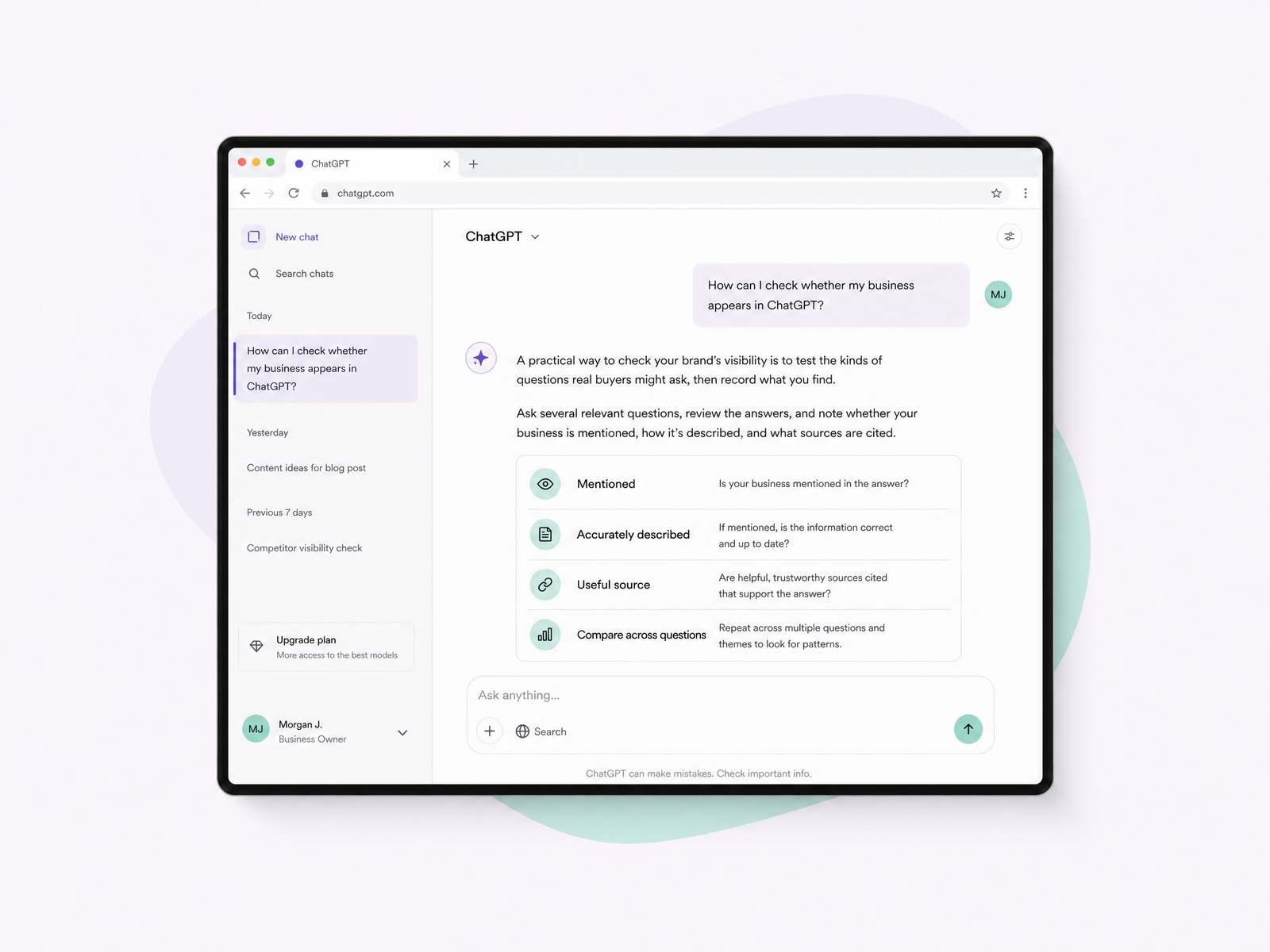
To check your brand visibility in ChatGPT, ask questions that resemble real buying situations. Test your category, service, comparison, location, and problem-based questions. Record whether ChatGPT mentions your business, recommends it, describes it correctly, and provides a source that supports the description.
Do not treat one answer as a ranking position. ChatGPT responses can change with the wording, date, browsing context, location, and available sources. A useful check looks for a pattern across several relevant questions.
A practical ChatGPT visibility self-check
The following check is appropriate when you want an initial signal before deciding whether to commission a specialist audit. It is intentionally limited. The purpose is to help you see the question a buyer is asking—not to turn a few prompts into a permanent visibility score.
1. Define the business you want ChatGPT to recognize
Write down the exact version of your business identity that a buyer should understand:
- The business name and primary category.
- The services or products you want to be known for.
- The customers or markets you serve.
- The geographic area, if location matters.
- The main reasons a qualified buyer should consider you.
This prevents the test from becoming vague. “Is my brand visible?” is less useful than “Would ChatGPT recommend Foundier as an AI SEO agency for a business that wants to be cited in AI search?”
2. Build a small buyer-intent question set
Use questions that reflect the journey from category discovery to provider selection. Do not only ask ChatGPT to repeat your company name.
| Question type | Example format | What it tests |
|---|---|---|
| Category | Who are the leading AI SEO agencies for a growing service business? | Whether your business is recognized in the category |
| Service | Which agency helps businesses improve visibility in ChatGPT and Google AI Overviews? | Whether your service offer is clear |
| Comparison | What should a business look for when choosing an AI search optimization agency? | Whether your business fits the selection criteria |
| Problem-led | My competitors are being recommended by ChatGPT but my business is not. Who can diagnose this? | Whether ChatGPT connects your offer to a buyer problem |
| Location | Which AI SEO agency serves businesses in [relevant market]? | Whether location and service-area signals are clear |
| Brand-specific | What does [Business Name] do, and who is it best for? | Whether the business is described accurately |
Keep the core questions stable if you plan to test again. You can add new variations, but do not replace the original set every time and then claim that the results are comparable.
3. Record the answer, not just the brand mention
For every test, save the date, exact question, whether browsing was enabled, the answer, the businesses named, and any links or sources ChatGPT provided. Then classify the result.
| Result | Meaning for the business |
|---|---|
| Not mentioned | ChatGPT did not connect the business with that question in the test context |
| Mentioned in passing | The business is recognized but may not be considered a meaningful option |
| Recommended | The business is presented as a possible choice for the question |
| Accurately described | ChatGPT explains the business, audience, and offer correctly |
| Cited with a useful source | The response provides supporting evidence that a buyer can inspect |
| Described incorrectly | The business identity or offer may be unclear, inconsistent, or poorly supported |
A mention is not the same as a recommendation. A recommendation is not the same as a citation. A citation is not automatically a good citation. The commercial value depends on the context and accuracy of the answer.
4. Compare the businesses ChatGPT names instead
The most useful part of the self-check is often the competitor list. If ChatGPT names three alternatives and not your business, record them. Look at the sources it uses to describe those alternatives and compare them with your own public evidence.
Ask:
- Are the competitors clearer about their category and services?
- Do their pages answer the question more directly?
- Are their names and descriptions consistent across the web?
- Do they have stronger public sources supporting their positioning?
- Is your business actually the right fit for the question, or are you testing an offer you do not clearly sell?
This comparison is where a simple check begins to become an audit. A full diagnosis requires doing it systematically across the questions, competitors, site structure, technical signals, and relevant sources that shape the result.
How to measure brand visibility in ChatGPT over time
Checking tells you what happened today. Measuring tells you whether anything is changing. To measure brand visibility in ChatGPT, run the same fixed question set on a regular schedule, such as monthly, and calculate four simple rates across it:
- Mention rate: the share of questions where your business appears at all.
- Recommendation rate: the share where it is presented as a viable choice, not just named.
- Accuracy rate: the share where your category, services, audience, and location are described correctly.
- Citation rate: the share where ChatGPT links to a source that supports the description, and whether that source is your own site or a third party.
Record the competitors named alongside you each time. A rising mention rate means little if the same three competitors are still recommended ahead of you. For a deeper framework, see AI search visibility metrics and KPIs that matter and how to track AI brand mentions and citations.
Why one ChatGPT check is not enough
A single prompt gives you one observation. It does not tell you whether the result is repeatable or why it occurred.
The business may be absent because ChatGPT cannot clearly identify the entity, because the service pages do not explain the offer, because the site is difficult to crawl or interpret, because the relevant evidence is buried, or because competitors have stronger corroboration. It may also be absent simply because the question does not match the business’s actual market or service scope.
A self-check cannot reliably separate those causes. It also does not test Perplexity, Claude, or Google AI Overviews, which may represent the business differently. A brand can appear in one AI experience and be absent in another.
That is why Foundier treats the self-check as a starting signal, not as a complete AI visibility measurement system. The AI Visibility Audit tests across four AI engines, reviews competitor citation patterns, examines the technical foundation, and delivers a prioritized plan rather than a screenshot collection.
What a specialist checks beyond the prompt
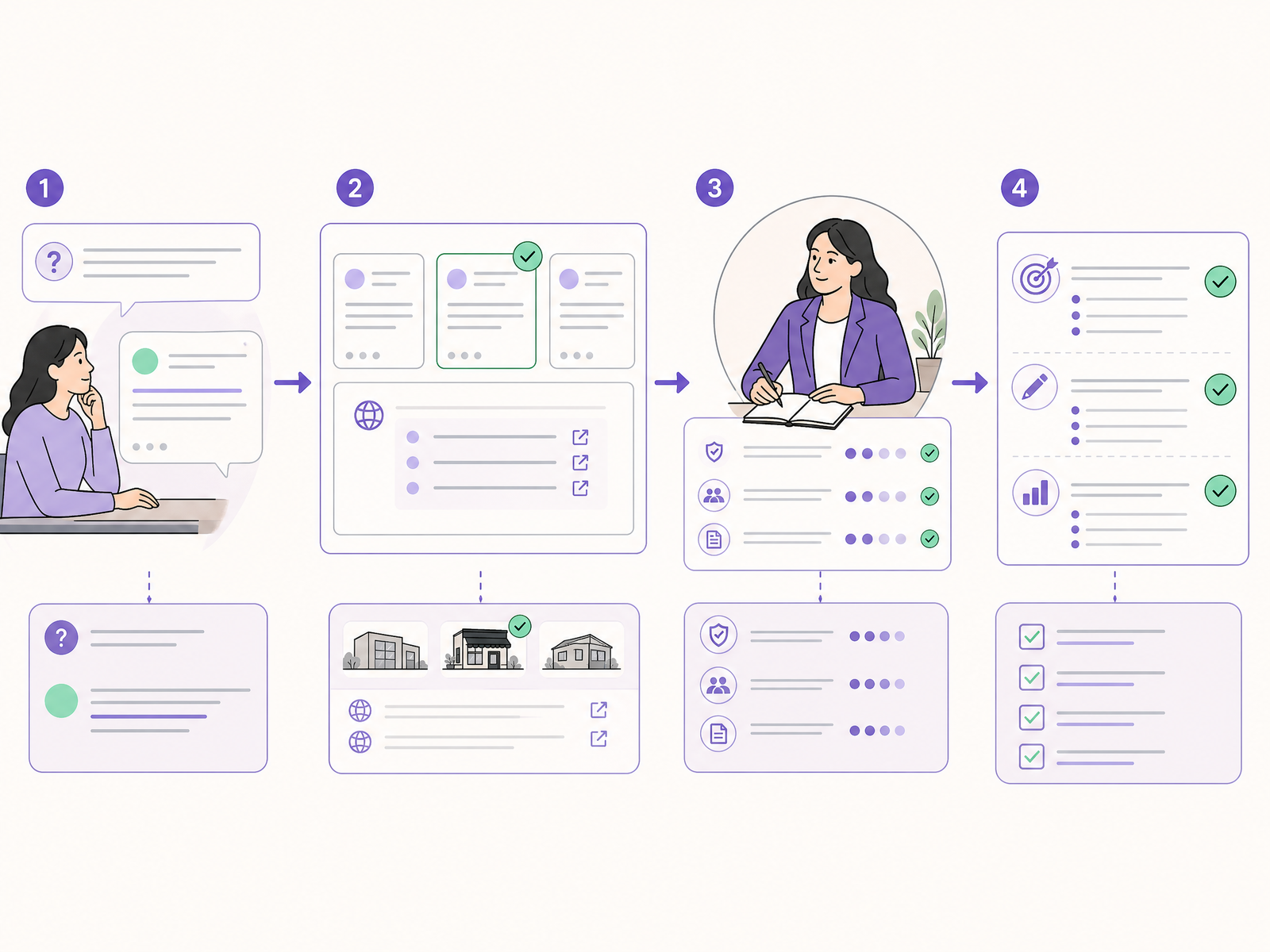
When Foundier investigates a visibility gap, the question is not simply “did the brand appear?” The work connects the answer to the evidence a business controls.
Entity clarity
Can a search system confidently understand who the company is, what it does, who it serves, and how it differs from alternatives? Are those facts expressed consistently on the website and relevant public sources?
Technical accessibility
Can important pages be discovered and interpreted? Are the site structure, internal links, canonical signals, and structured data helping or creating ambiguity? Are the visible claims supported by the page markup rather than hidden or disconnected information?
Service and content evidence
Do the priority pages answer the commercial questions directly? Is the offer specific enough for an engine to connect it with the buyer’s need? Does the content provide useful evidence rather than repeating a category phrase?
Competitor and source context
Who is being cited instead, and what makes their public evidence easier to retrieve or trust? Are there inconsistent descriptions, missing corroboration, or relevant sources that the business has not connected clearly?
Repeatable measurement
Can the same questions be retested later with the date, engine, location, competitors, answer, and sources recorded? Without consistency, a business cannot tell whether an apparent improvement is a real pattern or a one-time result.
What Foundier does after the check
Foundier does not ask a business owner to interpret a few prompts and implement a long generic checklist alone. The audit establishes what is happening before any larger scope is recommended.
The engagement can lead to several different paths:
| If the diagnosis shows… | Foundier may recommend… |
|---|---|
| The site is sound but the entity, service, content, or citation signals are weak | AI SEO Services with scoped technical, content, entity, and source implementation |
| Crawlability, schema, or site structure is the main constraint | Technical SEO + Schema |
| The current site needs a structural rebuild | AI-Ready Website Design |
| The foundation is in place and the business needs continuing measurement | AI Visibility Monitoring |
The audit is useful even when Foundier is not the implementation provider because the buyer receives a business-specific diagnosis and prioritized action plan. When Foundier carries out the work, the audit fee is credited toward the appropriate engagement.
For agency owners: use the check to open the conversation, not to sell a guarantee
If you run an agency, a client may ask whether your team can make the business show up in ChatGPT. You can begin with a few questions to demonstrate the issue, but you should not turn one result into a guaranteed ranking promise.
The better agency conversation is:
“We can see whether your business is being mentioned and how competitors are being represented. The next question is why. Foundier can provide the specialist diagnosis and implementation layer while we continue to own your broader marketing strategy.”
Foundier can support an agency through a referral, behind-the-scenes specialist delivery, or coordinated joint delivery. The agency keeps the client relationship and wider marketing context. Foundier contributes the AI visibility diagnosis, technical and content recommendations, implementation agreed in scope, and verification.
See the agency partner program if your agency wants specialist support for client work.
How to know when the self-check has done enough
Stop the manual test when you have enough information to make the next decision. You do not need to ask hundreds of prompts before learning that your business is missing from the buyer questions that matter.
A specialist audit is justified when:
- Competitors appear consistently and your business does not.
- ChatGPT describes your business inaccurately or places it in the wrong category.
- Your business appears occasionally, but you cannot explain the pattern.
- You need to know which technical, content, entity, or source issue to fix first.
- You are responsible for an agency client and need a defensible delivery process.
- You want implementation rather than another report or dashboard.
A self-check is not wasted effort. It becomes wasted effort when it replaces diagnosis, creates false confidence, or leads to uncoordinated website changes.
ChatGPT brand visibility services: when to get help
A self-test tells you what ChatGPT says. It does not tell you why, and it cannot change the answer. Bring in help when the test shows a pattern rather than a one-off: competitors named across most of your buyer questions, an outdated or wrong description of your services or prices, or citations that point to directories and reviews you do not control.
Foundier’s AI SEO service covers ChatGPT, Claude, Gemini and Perplexity: a model-by-model baseline, a brand accuracy review, entity and schema fixes, answer-first page rewrites and a corroboration plan, re-tested at delivery. Fixed tiers start at $3,000, and the $750 AI Visibility Audit is credited toward any tier booked within 60 days.
Related guides: ChatGPT ads: how advertising on ChatGPT works · What is AEO? Answer engine optimization explained
Frequently asked questions
How do I check my brand visibility in ChatGPT?
Ask ChatGPT several buyer-intent questions about your category, services, competitors, and customer problems. Record the exact answers, date, browsing context, businesses named, descriptions, and sources. Treat the result as an initial signal rather than a stable ranking measurement.
How do I measure brand visibility in ChatGPT?
Run the same fixed set of buyer questions on a regular schedule and track four rates: how often you are mentioned, how often you are recommended, how often you are described accurately, and how often a supporting source is cited. Compare those rates with the competitors named in the same answers.
How do I track whether my brand shows up in ChatGPT search results over time?
Keep a simple log for every test: date, engine, exact question, browsing state, location, businesses named, description, and sources. Repeat the same questions monthly. A consistent log shows whether a change is a real trend or a one-off answer.
Why does my business appear in one ChatGPT answer but not another?
The wording, context, date, browsing state, location, available sources, and question intent can change the response. A repeatable set of questions gives you a better pattern than one isolated prompt.
Is a ChatGPT mention the same as a recommendation?
No. A mention only means the name appeared. A recommendation means the business was presented as a viable choice for the question. You should also check whether the description is accurate and whether a useful supporting source was cited.
Can I use ChatGPT to diagnose why my business is not visible?
ChatGPT can help you generate questions, organize observations, and identify possible explanations. It cannot replace a site-specific audit that compares competitors, reviews technical signals, checks public evidence, and prioritizes implementation work.
Should I test other AI search engines too?
Yes, if AI visibility is commercially important. ChatGPT, Perplexity, Claude, and Google AI Overviews may produce different results. Foundier’s audit tests all four so a decision is not based on one engine’s answer.
Who can audit whether my company appears in ChatGPT answers?
Look for a specialist that tests a documented question set across several AI engines, records competitors and sources, separates observed results from interpretation, and gives you a prioritized fix list rather than a score. Foundier’s AI Visibility Audit does this across ChatGPT, Perplexity, Claude, and Google AI Overviews in five business days.
What do ChatGPT brand visibility services include?
Credible services usually cover three stages: diagnosis (testing buyer questions and identifying why competitors are named instead), implementation (entity, content, technical, schema, and source improvements), and verification (retesting the same questions to confirm change). Be cautious of any service that guarantees a specific ChatGPT placement.
When should I hire an AI visibility specialist?
Hire a specialist when the issue is unclear, competitors are being recommended instead, the problem crosses technical and content disciplines, or you need someone to implement and verify the work. Foundier starts with a $750 five-day audit so the next scope is based on evidence.
Turn the ChatGPT check into a business decision
Checking your brand visibility in ChatGPT is useful when it leads to a better question: what is preventing the right business from being understood and recommended for the questions that matter?
You can run the initial check yourself. Foundier can take responsibility for the work after that: test the broader pattern, compare the competitors, diagnose the evidence gap, implement the right changes, and verify representative questions.
The next step is the AI Visibility Audit: $750, five business days, four AI engines, a finished diagnosis, and a prioritized action plan. The fee is credited toward a Foundier engagement booked within 60 days and fully refunded if Foundier misses the five-business-day deadline.
Not ready to buy yet? Get a free AI visibility snapshot: five buyer questions across four AI engines, who is named instead of you, and three fixes, in your inbox within 48 hours.

Ahmad is the Founder of Foundier, an AI SEO agency that gets businesses recommended by ChatGPT, Perplexity, Claude, and Google AI Overviews. His focus is simple: when your buyers ask AI who to hire, your name should be the answer, not a competitor's.